Blog

Microfilm Behind the Scenes: Our Work with The Crown and Television Productions

Discover how UK Archiving works with television and film productions, including Netflix's The Crown, to create authentic microfilm reels that bring historical research and archival scenes to life. 

Amy McVeigh·November 17, 2026
Estimated reading time: 8 minutes
Share
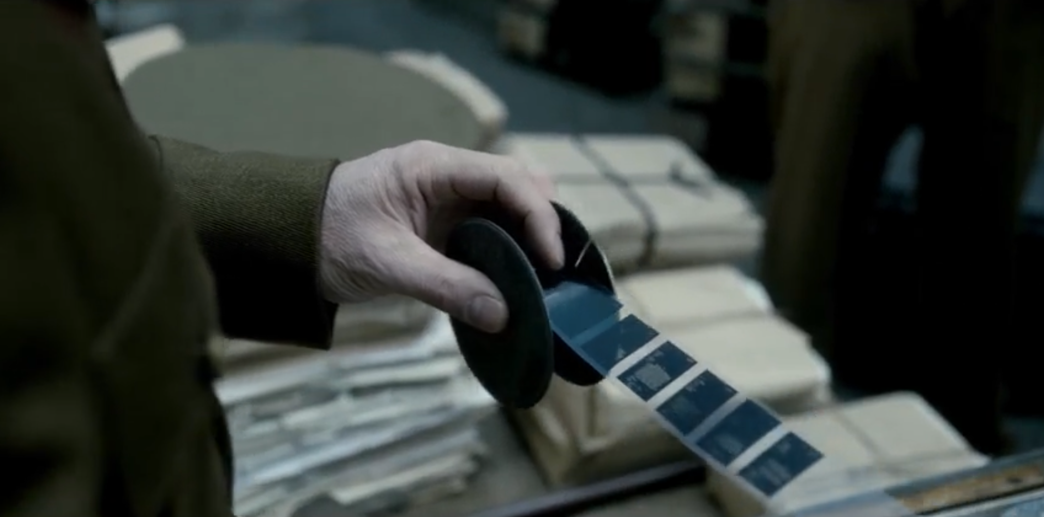
A hand holding a small reel of microfilm, with a strip of film frames unspooled across a table piled with bundles of old papers, in a scene from The Crown.
Microfilm from S2E6 of The Crown. Still taken from: The Crown (netflix.com)

When you think about archives, you no doubt think about shelves stacked high with old boxes and books, waiting to be retrieved and studied. Or perhaps digital archives, containing thousands of images ready at the click of a button. If you have visited a library or archive, you might also have noticed a peculiar-looking machine in the corner, or members of staff stacking little square boxes into neat rows. Well, it’s microfilm! 

Microfilm is a preservation technique used in heritage before digital preservation existed. Essentially, high-quality cameras capture images of documents, which are then processed so people can study the original items without having to handle them and potentially damage them. Unlike digitisation, which produces images you can view on a computer, microfilm cameras produce images on reels of film that can be viewed using a microfilm reader. 

UK Archiving began in 1994 as an effort to preserve Scottish newspapers onto microfilm. We have been producing microfilm consistently ever since, so if you have visited a library to research Scottish history and newsprint, you may well have encountered microfilm produced by us. 

You might also have seen our work through an entirely different screen – on your TV! Not only is microfilm a robust and handy tool for research and heritage preservation, but it has also been used to tell stories about archives and history via TV and film.   

We have produced several microfilms specifically for TV, for shows like The Crown and Sister Boniface Mysteries, which have used our reels in scenes to depict investigation and research.   
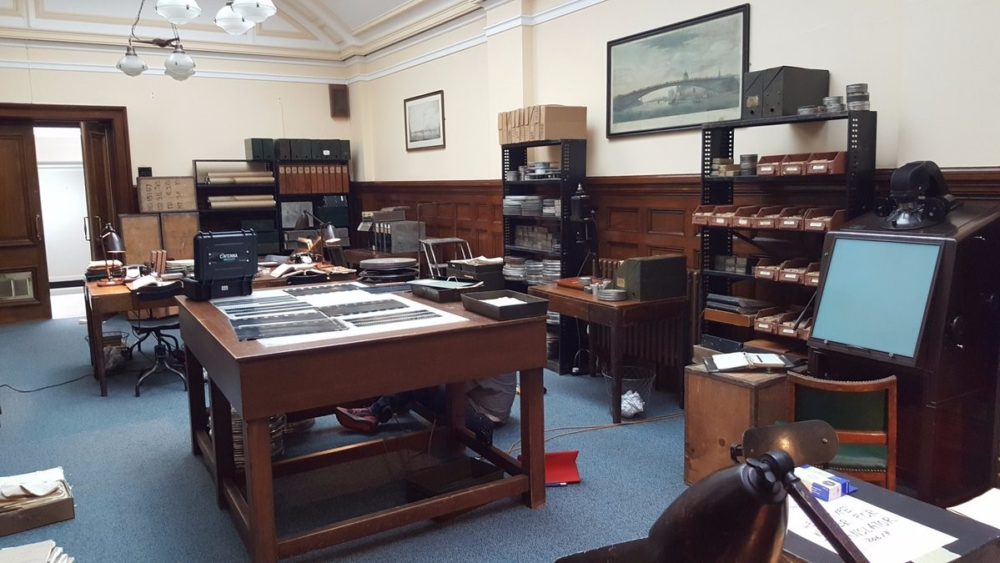
A period archive room with wood-panelled walls and wooden desks, laid out with strips of film, metal film canisters, shelves of storage boxes and a large vintage microfilm reader.
Photograph: genusit.com

Why Historical Productions Need Microfilm? 

There are so many ways to create a sense of time and place in TV and film, so why microfilm? 

In shows like The Crown, cast and crew are tasked with recreating real events from history. Microfilm has a long history of practical use, particularly when preserving documents during war and conflict. 

Did you know? One of the first large-scale uses of microfilm was during the Franco-Prussian War, when messages were captured onto microfilm and attached to carrier pigeons to deliver covert communications during the Siege of Paris. 

During the Second World War, "microphotography was used extensively for espionage and for regular military mail" (UCLA). So, when researching these periods of history, as in S2E6 of The Crown, microfilm was the real method of research, and so replicating it adds legitimacy to depictions of real historical events. 

But alongside historical accuracy, using microfilm evokes a grounded, authentic sense of time and place, just like costumes, sets and props help audiences feel immersed in a story. Shows like The Crown can, and have, used legitimate historical props, like a restored 1940's microfilm reader, to make period events feel and look authentic. 

Of course, this is not always possible with the microfilm reels themselves, which is why companies like us are used to produce recreations that bring further life to a scene. 

A director, technical crew and props department have to consider how best to share information, create a tactile and lived-in setting, and use believable props to demonstrate a sense of history. They have to remind us what research was like for characters in a pre-digital world. 

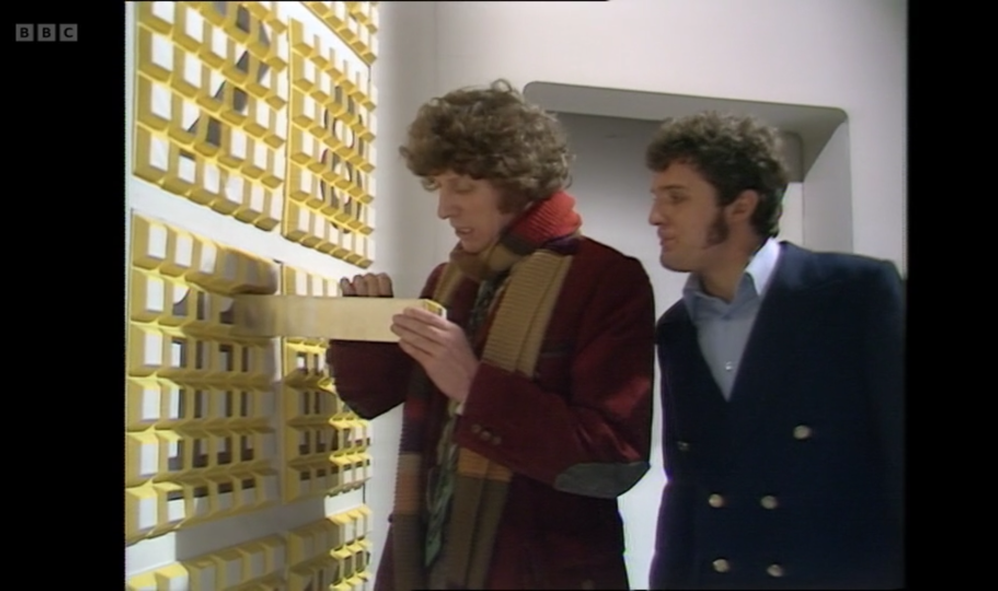
The Fourth Doctor and Harry Sullivan pull a drawer of microfilm out of a yellow storage wall aboard the space station in the 1975 Doctor Who serial The Ark in Space.
Microfilm on Doctor Who (1975). Still Taken From: Doctor Who (bbc.co.uk)

"Microfilm machines evoke a sense of nostalgia, grounding stories in a tangible, tactile reality. They’re perfect for building suspense, as viewers watch characters painstakingly sift through images and text in search of that one crucial detail."

cull.co.uk

Younger generations are increasingly used to the instant and convenient methods of research that the Internet and digital resources provide, and are forgetting the time, tactile care and focus that analogue investigation and learning used to take. Whilst microfilms are still being produced today, they are becoming less widely used, especially in user-facing scenarios. 

Even organisations that use microfilm often do so alongside digitally scanned versions of reels to make accessibility and sharing easier. The likelihood of someone visiting a library or archive and using a microfilm reader is becoming smaller, and knowledge about microfilm and its place in archival history is becoming less widely known. 

There is, therefore, something intriguing and special about seeing it on screen. Microfilm becomes a symbol of history in itself, demonstrating a time when physical media was all people could rely on. Finding vital information meant sourcing the correct reel, loading it into the reader, then using cranks or buttons to wind through every page until you found what you were looking for. 

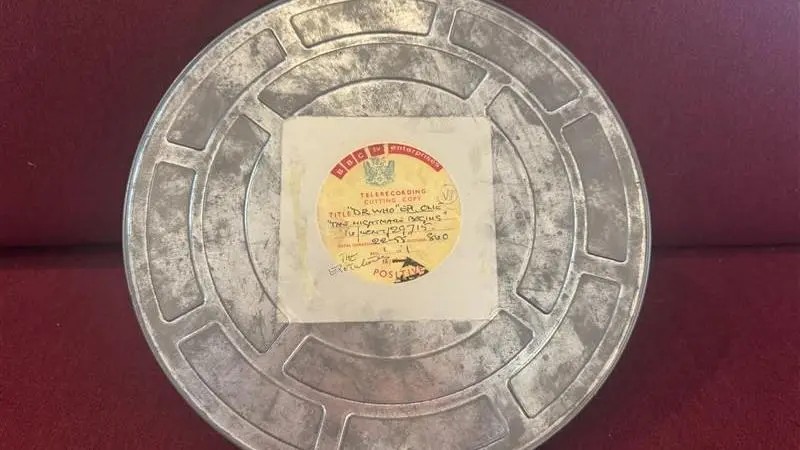
A worn metal film canister with a BBC Enterprises telerecording label handwritten "Dr Who" and "The Nightmare Begins".
Photograph: BBC

When Microfilm Becomes Part of the Story 

Creating a 'fake' microfilm reel for television might seem complicated, but the process is pretty similar to the microfilm we produce every day. The content the client wants to capture is sent to us, and we use a microfilm camera to capture it, process it, quality assure it, correct any errors, then duplicate as many copies as needed. 

The main challenge in making reels for TV or film is ensuring the content looks as authentic as everything surrounding it on screen. We need to consider things like distressing, and making the content we are asked to film to look as close to a, for example, 1960's newspaper, as we can. 

If a page is going to be used in a scene to convey information to an audience, we also need to consider scale and framing during capture to make sure everything is legible, even through an antique microfilm reader and a TV camera lens. 

Like with all our projects, digital and microfilm, an open and collaborative dialogue with our clients allows us to create images that exactly fit their needs, even in unusual projects like making microfilm for TV. 

A Sci-Fi Vision of Long-Term Preservation 

In the 1970s, microfilm was still a much bigger part of typical archiving practices and the cultural imagination around information storage technology. That is why, in the 1975 episode of Doctor Who, The Ark in Space, The Doctor discovers a space station in the 30th century that stores all human knowledge using microfilm. 

To the modern ear, this idea sounds dated and even silly: that thousands of years in the future, technological advancement hasn't moved beyond microfilm. It's even silly enough to have become an entry on the website TV Tropes. But even TV Tropes points out the legitimate uses of microfilm in a technological age. 

"Storing the information on a solid state format that does not require power to operate ensures the data isn't lost by a computer failure over the long ages until awakening. It can also be read (at a pinch) with a torch and a magnifying glass and so doesn't require precious power needed for other duties like say... keeping the humans alive."

tvtropes.org

You might only see it on screen, but microfilm is still being used and produced, even in an increasingly digital world. And with increasing cultural anxieties around data storage/security, and the general acceleration of widespread dependence on digital resources, some are worried about how culturally and historically significant items and information will be stored in the far future. 

It is impossible to know what digital technology will look like in 100 or 200 years. Hopefully, it will continue to make information convenient and accessible, as it has since the birth of the Internet. But what I do know is that a reel of microfilm, when stored properly, retains high-resolution images for 500 years without relying on technology. All you need is a light and a lens, and information from centuries ago will be right in front of you. 

Analogue preservation is not just part of the imagined future in a show like Doctor Who. It is, in fact, a tangible part of its present. As you might have seen, multiple episodes of classic-era Doctor Who, long deemed 'lost media', have been discovered and restored in the past few years. 

This has only been possible because of the persistent passion of experts in film restoration and preservation. If we forget how to make and care for analogue preservation formats like microfilm, future discoveries of potentially vital information may not be restored to their best condition or preserved for as long as possible. 

Keeping historic, analogue methods of preservation within cultural memory is so important. Not just to give historic scenes in film and TV a more authentic tone, but to remind audiences what came before, and that there are always more ways to solve problems and preserve history and culture than we think. 

We are proud to continue producing microfilm and preserving digitally too. The dream would be a future where digital and film preservation work hand in hand, giving us the benefits of both. But the only way to achieve that is to explore and educate widely about the benefits of all kinds of preservation, so future generations have every tool at their disposal to remember the past and preserve their present. 

Related content

More on this topic

Other case studies and articles sharing the same sector or service.