Case Study
Preserving the 172-Year-Old Morpeth Roll
Digitising one of Ireland's most extraordinary historical artefacts, a 420-metre-long scroll containing approximately 160,000 signatures collected across Ireland in 1841.
Overview
The Morpeth Roll is one of the most significant surviving historical documents from pre-Famine Ireland. Created in 1841 as a farewell testimonial to George Howard, Lord Morpeth, Chief Secretary for Ireland, the roll contains approximately 160,000 signatures gathered from every county in Ireland in just six weeks. The signatures were collected on 652 individual sheets, which were later joined together to form a continuous scroll measuring 420 metres in length.
After spending more than a century stored in the basement of Castle Howard in Yorkshire, the Morpeth Roll was rediscovered and became the focus of a collaborative digitisation project led by Ancestry.co.uk, Maynooth University, the Russell Library and Castle Howard.
UK Archiving was commissioned to carry out the specialist on-site digitisation at Maynooth University, creating a complete digital archive while preserving the integrity of this unique historical artefact.
The Client
Ancestry.co.uk
Ancestry.co.uk is one of the world's leading family history platforms, providing access to billions of historical records that support genealogy and academic research. Working alongside Maynooth University, Castle Howard and the Russell Library, Ancestry helped make the Morpeth Roll available online, allowing researchers to explore one of the few surviving large-scale records of Irish people before the Great Famine.
The Challenge
Digitising One of Ireland's Longest Historical Documents
The Morpeth Roll presented an exceptionally complex digitisation challenge unlike a conventional archive or bound volume.
Measuring 420 metres in length and constructed from 652 joined sheets of paper, the roll could not simply be laid out or photographed using traditional capture methods. Instead, every section had to be carefully unrolled, supported, photographed and rewound without placing unnecessary stress on the historic paper.
The project was carried out on-site in Ireland, requiring specialist imaging equipment to be transported and installed within a temporary digitisation studio. Every stage of the workflow had to minimise handling while maintaining consistent image quality across the entire length of the document.
Our Approach
Designing a Bespoke Capture System
Working alongside the project partners, UK Archiving designed and installed a bespoke digitisation system specifically for the Morpeth Roll.
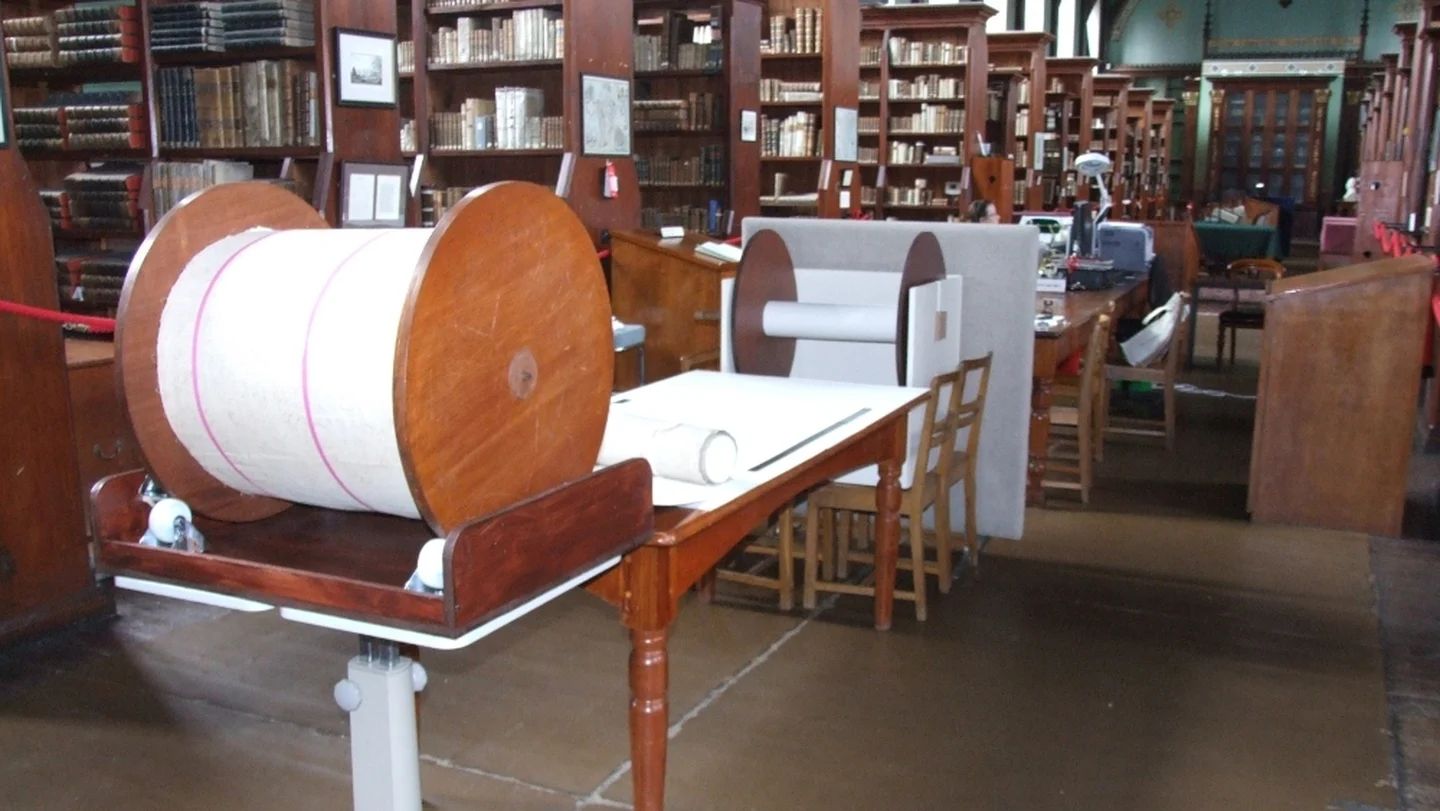
A custom rolling table fitted with large support bobbins allowed the scroll to be safely unwound from one side and re-rolled onto the other. Positioned above the table, a high-resolution overhead camera system captured each section individually while maintaining consistent alignment and lighting throughout the project.
Each image was captured with a small overlap, allowing every section to be digitally stitched together into one continuous, full-length representation of the original document. During capture, both sides of the roll were examined to ensure that important annotations, stamps and written material on the reverse were also recorded where required.
Following image capture, the files were processed to create a full-scale digital version of the scroll before being supplied to Ancestry, where the signatures were indexed and transcribed to support online searching.
Result
Preserving an Unique Piece of Irish History
We completed the digitisation over the course of one week, producing a high-resolution digital record of the complete Morpeth Roll.
Today, the digital collection enables historians, genealogists and members of the public around the world to study one of the most significant surviving records of Ireland before the Great Famine. Because many nineteenth-century Irish census records were later destroyed, the Morpeth Roll provides an invaluable resource for historical and family history research while dramatically reducing the need to handle the original fragile document.
Related Services
Heritage Digitisation
Learn moreCultural Heritage
Learn moreDiscover More Success Stories
Protect Your Collections With Confidence
Transform your archive into an accessible digital resource with expert support from a team experienced in handling complex and valuable collections.